


Welcome Guide
Everything you need from the first idea to your first week on the island — choosing a programme, getting accepted, travelling here, and settling into a new home in Crete.
Before You Visit
5 steps to prepare
Trip Planning
Getting to campus
After Arrival
Phone, AFM, bank, permit
Accommodation
Finding & renting
Before you visit
Five steps to prepare your stay
Your journey starts long before you land. Work through these steps in order — from choosing a programme to securing a place to stay.
1
Find your programme of studies
Look for a study programme that matches your interests and check its eligibility criteria. Browse the websites of the programmes you like for their requirements and application process — most international programmes at the University are free to attend.
2
Check the destination area
Research the cost of living and the character of the area. Crete is an affordable, beautiful place to live, with safe, lively cities full of cafés and nightlife. Note that the campuses sit just outside the city centres — but bus connections are regular, even during working hours.
3
Apply and get accepted
Apply to your chosen programme. Once accepted, the department issues a certificate of acceptance — or, for non-EU residents, an eligible acceptance letter you can use to apply for a visa.
4
Apply for a visa, if you need one
If your country of origin is not an EU Member, you are advised to contact the Greek Embassy or Consulate in your home country for entrance regulations prior to your departure.
Students
Apply for a student visa at the Greek embassy or consulate, with a letter from the University stating the reason and duration of your stay.
Researchers
Apply for a Type D visa, with the hosting agreement and an invitation letter from the University of Crete.
Family members: All students and researchers (EU & non-EU citizens) planning to bring their families here for the duration of their studies / contract are advised to bring with you documents required by the Greek public services. These are: copies of your marriage certificate and the birth certificates of your children which have been verified as true copies – ie stamped with an Apostille stamp by the authority that issued the certificates in your country. This should be done prior to arrival.
Note: entry with a tourist visa is not acceptable for students /researchers accepted for studies/ a contract at the University of Crete.
After Arrival
Your initial entry visa is a 3-month single entry visa.
On arrival, if your study/contract period is longer than 3 months, you will need to apply for a residence permit which will be valid for the duration of your studies/contract and, for researchers
Applications for residence permits are made at the Immigration Office of the Muncipality inHeraklion and in Rethymno
Apart from the residence permit, Researchers from EU countries and from non-EU countries will need to follow a number of specific steps for tax registration, renting a house, your employment contract, opening a bank account, health and social insurance procedures and related matters.
.
For further information see the step-by-step information and advice contact us at any time before or after your arrival.
5
Find a place to stay
Crete is a very popular destination and accommodation options have become a bit scarce, but after some research, the majority of visiting students and researchers find a place to stay. One of the problems is that after Airbnb was introduced, many homeowners prefer to have their places available for tourists in the summer and do not offer a full year stay. On the positive side, Airbnb offers many options for a short stay and after the tourist season you can find many places in renovated condition. The University’s International Relations Office could offer some guidance, however most visitors usually find solutions in popular forums and pages.
Trip planning
Two airports, three ports
Crete has two airports and three ports. Airports are most common for international travellers, while ferry boats are handy if you're coming via Athens.
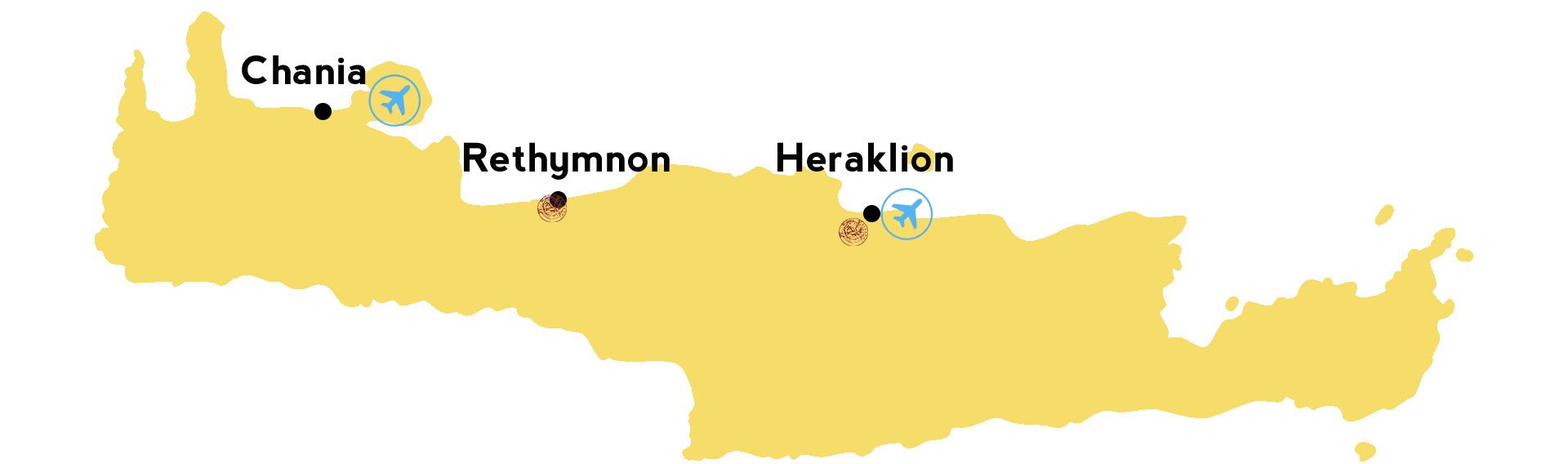
Chania - Rethymno - Heraklion
- 1 By Air
- There are airports in Heraklion (airport code: HER) and Chania (airport code: CHQ) with direct regular flights to/from Athens airport (duration 45 minutes), which is the main international hub for Greece. There are also regular flights to/from Thessaloniki and other domestic routes. Daily domestic and connecting flights are provided by Aegean Airlines and Olympic Air. During the summer months there are direct charter flights to airports in Crete and to most major European destinations.
There is a bus service and taxi rank at Heraklion airport. Rides between the airport and the city centre take approximately 10 minutes. - 2 By Ferry
- There are daily ferries between Heraklion and the mainland port of Piraeus. Daily ferry services are also available directly between Piraeus to/from the Souda port in Chania. For information on schedules and prices, please visit the Minoan Lines and ANEK Lines websites.
- 3 By Bus & Ferry
- The public bus service, KTEL, has combined bus-ferry schedules running daily to/from Heraklion and major towns in mainland Greece. For timetables and prices, please visit the inter-city KTEL website.
Gallos Campus — Rethymno
Philosophy, Education & Social Sciences
The Schools of Philosophy, Education and Social Sciences are located at the University’s Gallos Campus in Rethymno
Rethymnon is located 90 km west of Heraklion and 70 km east of Chania, linked by the island’s main east-west highway. Journey time from either destination to Rethymno is about an hour.
If you are arriving by air or sea in Heraklion or Chania, KTEL public bus service provides an economic means of getting to Rethymno. For timetables, please visit KTEL website. Taxis from Chania or Heraklion to Rethymno are also available from the taxi ranks at airports and ports.
Gallos University Campus is located about 4km from down town Rethymno. There is a regular bus service between the town and campus every 15-20 minutes. Alternatively, a taxi takes between 10-15 minutes.
Voutes Campus — Heraklion
Sciences, Engineering & Medicine
Voutes Campus is about 10km from Heraklion city centre, at the area of Vassilika Vouton. All Departments of the School of Science & Engineering (Biology, Chemistry, Physics, Materials Science, Mathematics & Applied Mathematics, Computer Sciences,) as well as the School of Medicine and the adjoining University General Hospital are housed there.
There is a regular bus service every 15 minutes between Voutes campus and the city centre (Eleftheria’s Square), journey time about 35-40 minutes. Tickets can be purchased at kiosks next to bus stops, or ticket machines in central stops. Alternatively, a taxi takes about 20 minutes.
After arrival
Your first-week checklist
Four essentials to set up once you land — do them in this order, since each one tends to need the previous.
A Greek phone number
Handy for daily life and often required to open a bank account. EU SIMs work but roaming may cost more; some non-EU phones aren't GSM-compatible. Visit a local provider with your passport. 02 A tax number (AFM) The Αριθμός Φορολογικού Μητρώου is your fiscal number, needed to pay taxes, work and study. Bring an official acceptance or contract, a valid passport,
Handy for daily life and often required to open a bank account. EU SIMs work but roaming may cost more; some non-EU phones aren't GSM-compatible. Visit a local provider with your passport. 02 A tax number (AFM) The Αριθμός Φορολογικού Μητρώου is your fiscal number, needed to pay taxes, work and study. Bring an official acceptance or contract, a valid passport,
A bank account
In order to open a bank account in Greece it is necessary to have an official letter of acceptance /contract issued by the host / employee, AFM, valid passport, Residence proof (renting contract , electrical bill, phone bill) and Greek phone number. 02 A tax number (AFM) The Αριθμός Φορολογικού Μητρώου is your fiscal number, needed to pay taxes, work and study. Bring an official acceptance or contract, a valid passport,
In order to open a bank account in Greece it is necessary to have an official letter of acceptance /contract issued by the host / employee, AFM, valid passport, Residence proof (renting contract , electrical bill, phone bill) and Greek phone number. 02 A tax number (AFM) The Αριθμός Φορολογικού Μητρώου is your fiscal number, needed to pay taxes, work and study. Bring an official acceptance or contract, a valid passport,
Opening an accountA residence permit
Regardless of visa papers, every visitor should also apply for a residence permit, apart from tourist visits up to three months (90 days). Your application will be checked and processed on the local centre of permits. The permits authority will guide you on the requested process depending on your visa and visiting status. However, the most usual steps are the following: Issue a permit fee ticket (called para’volo in Greek)
Regardless of visa papers, every visitor should also apply for a residence permit, apart from tourist visits up to three months (90 days). Your application will be checked and processed on the local centre of permits. The permits authority will guide you on the requested process depending on your visa and visiting status. However, the most usual steps are the following: Issue a permit fee ticket (called para’volo in Greek)
Pay the paravoloA tax number (AFM)
An AFM is a number that identifies individuals and legal entities in Greece. The “Arithmos Forologikou Mitroou”, or AFM, is a fiscal number that is used throughout Greece to pay taxes, work and study. To achieve an AFM in Greece one needs to have an official acceptance for collaboration / contract, valid passport, Visa for entering Greece and application document issued by the particular service. For more information please check: 02 A tax number (AFM) The Αριθμός Φορολογικού Μητρώου is your fiscal number, needed to pay taxes, work and study. Bring an official acceptance or contract, a valid passport,
An AFM is a number that identifies individuals and legal entities in Greece. The “Arithmos Forologikou Mitroou”, or AFM, is a fiscal number that is used throughout Greece to pay taxes, work and study. To achieve an AFM in Greece one needs to have an official acceptance for collaboration / contract, valid passport, Visa for entering Greece and application document issued by the particular service. For more information please check: 02 A tax number (AFM) The Αριθμός Φορολογικού Μητρώου is your fiscal number, needed to pay taxes, work and study. Bring an official acceptance or contract, a valid passport,
How to get an AFMResearchers from non-EU countries follow a few extra steps — tax registration, renting a home, an employment contract, a bank account, and health and social insurance. The Welcome Office can walk you through it step by step.
Accommodation
Finding your home in Crete
The University of Crete does not provide accommodation options on campus for visiting students and staff.
Please make your plans to find what suits your needs, with the following guidelines.
Initially, start by figuring out exactly what you want. This will help you narrow down the list of options and therefore facilitate and speed up the renting process.
Think about whether you want to live alone or you want a flat mate, if you are available to share with others, what neighborhood are you interested in, how many rooms should there be, what floor is comfortable for you, and the maximum amount of money you are willing to spend for the monthly rent.
These are just some of the things you should consider before starting out the search for an apartment.
However, apart from these, there are a few other things you should know.
Let’s go through them together.
What documents do I need to rent?
Documents reassure a landlord you're a trustworthy tenant — and protect your rights too. Here's what's essential.
- A Copy of your ID or passport
- Signing the tenancy agreement or simply looking at the flat (in most cases) requires you to provide a copy of your ID or passport, to either the landlord, estate agent, or both.
- B Tax Identification Number
- In order to be able to rent a flat in Greece, you will need a certification of your tax identification number (unless you are an Erasmus+ student residing in Greece for less than 6 months).
- C Tenancy agreement MA
- Having a rental contract is good since it ensures your rights as a tenant and elaborates on the do’s and don’ts to avoid any misunderstandings in the future. A signed tenancy agreement from both the landlord and the tenant is mandatory. The Agreement has to be written in English, otherwise, it is invalid.
- D Acceptance of the tenancy agreement
- Up to 30 days after signing the tenancy agreement, your landlord has to declare it to the Taxisnet portal in order for you to accept it.
How do I find accommodation in Greece?
Some of the most common ways of renting are:
- A Renting through an estate agent
- You can rent an apartment through an estate agent, but it usually comes at a price. Estate agents are hired by owners to help in selling or renting their apartments or houses. However, fees are included for the services provided by the agents.
But you’re not always the one to pay the commission, unless you’re planning on buying a property. So, when it comes to renting, the landlord usually pays the commission, that’s why people usually prefer using websites instead of employing an agent. However, before signing any agreement, make sure you check how these commission fees are to be paid. - B Renting without an estate agent
- After your arrival, you can go around neighbourhoods with a Greek-speaking friend, and look out for the yellow “ΕΝΟΙΚΙΑΖΕΤΑΙ” (“FOR RENT”) signs. This method might sound a little old-fashioned, but it still works. When looking at where to stay for long term, keep in mind that rental prices for apartments are negotiable. You’ll have a much better chance of arriving at a lower deal than advertised if a Greek speaking friend does the talking!
Another renting possibility is through word of mouth. It proves to be an efficient way of finding a nice and comfortable apartment. Usually, when someone wants to leave an apartment, they will suggest their friends or acquaintances to their landlords. This way, the landlord won’t have to worry about finding a new tenant, and you won’t have to worry about finding a flat. - C Available online property portals
-
There are various ways one can search for accommodation in Crete. You can find below a list of online pages proposed by past visitors and Erasmus students. Attention: the following are private pages suggested by past visitors and they are not affiliated to the University of Crete. Always check for scammers and fake advertisements.
- For the Rethymno area:
FOR SALE OR WANTED IN RETHYMNO – CRETE
https://www.facebook.com/RethymnoYouthHostel/
Accommodation Erasmus in Rethymno
- For the Heraklion area:
https://www.spiti24.gr/en/to-rent/property/prefecture-heraclion
https://www.facebook.com/groups/AccommodationHeraklionCrete
https://www.facebook.com/groups/255863288183521
- General pages for accommodation:
Golden οpportunity (XE)
Expats in Greece (FB group)
- D Through Study in Greece
- Study in Greece (SiG) is Greece’s official body for the internationalization of higher education and international student mobility. It helps you find the right accommodation for you. Working in close collaboration with their network of specialized external partners they provide a variety of housing options to students of all programs.
Visit the Study in Greece Helpdesk: https://helpdesk.studyingreece.edu.gr for further help and information.
What does the rental contract contain in Greece?
Documents reassure a landlord you're a trustworthy tenant — and protect your rights too. Here's what's essential.
- Duration of the agreement (start and termination dates)
- Additional costs depending on use, and rent-increase terms
- Deposit amount and monthly rent
- A list of furniture, if the flat is furnished
- Building rules, and house rules on repair expenses
- Notice length (minimum one month) and consequences of infringements
The cost of renting
What renting in Crete costs
Priced per square metre
Rents vary with location; flats close to the universities cost more.
Deposit ≈ two months' rent
A security deposit (no more than two months) ensures the property is returned in good condition.
Utilities usually extra
Electricity, water, gas and phone are normally not included — this should be stated in the contract.
Communal costs (koinochrista)
Most blocks share standard costs — cleaner, gardener, lift maintenance and lighting for stairwells and corridors.