

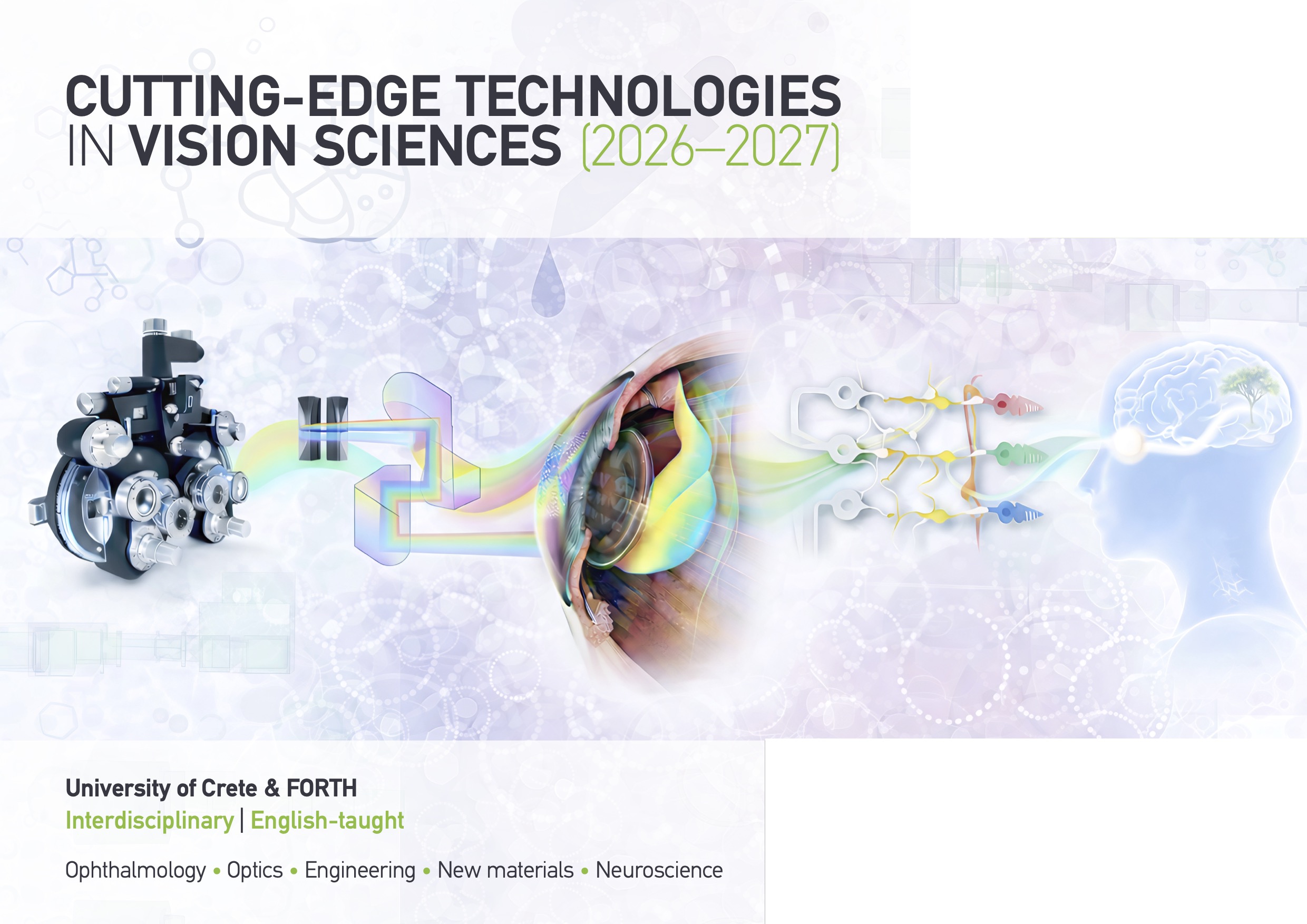
What happens when medicine, engineering, physics, and data science converge to tackle some of the most complex challenges in eye health?
In this interview, Professor Miltiadis Tsilimbaris explains how the MSc in Cutting Edge Technologies in Vision Sciences at the University of Crete is redefining postgraduate education. Built in close collaboration with Foundation for Research and Technology – Hellas (FORTH), the program offers an interdisciplinary, English-taught experience that connects scientific discovery with real-world clinical innovation.
For students interested in ophthalmic imaging, neurotechnology, drug delivery, and the future of biomedical research, this MSc provides a distinctive pathway to careers at the forefront of vision science and healthcare technology.
– What makes this MSc in Vision Sciences different from a traditional optics or neuroscience program?
This MSc in Cutting Edge Technologies in Vision Sciences stands out from traditional optics or neuroscience programs because it is designed from the ground up as a truly interdisciplinary and translational program. Rather than teaching each discipline separately, it integrates medicine, physics, mathematics, engineering, materials science, imaging, and informatics around real problems in vision science and ophthalmic technology. The curriculum combines strong scientific foundations with hands-on exposure to clinical applications, innovation, and emerging technologies in areas such as ophthalmic imaging, neurophysiology, drug delivery, and ophthalmic oncology.
– How do students benefit from the program’s interdisciplinarity and collaborations in practice?
Students benefit from this interdisciplinarity in very practical ways. They work with faculty and laboratories from multiple departments of the University of Crete together with FORTH, one of the leading research institutions in Greece. The transdisciplinary modules of the 3rd Semester are organized around real scientific and clinical challenges, allowing students from different backgrounds to collaborate and apply their expertise in a research-oriented environment. In practice, this means access to advanced laboratories, interaction with clinicians and researchers, and opportunities to participate in projects that bridge fundamental science and real-world healthcare innovation.
– For a prospective student choosing between postgraduate programs in Europe, why would you say this MSc is a particularly exciting and valuable choice right now?
For a prospective student, comparing postgraduate programs in Europe, this MSc is particularly exciting because it combines several strengths that are rarely found together: a highly international and English-taught environment, strong research performance of the faculty, close collaboration with a major research center, and direct links to rapidly evolving fields in vision technologies and biomedical innovation. At the same time, the program builds on the successful legacy of the long-running “Optics and Vision” MSc, whose graduates have gone on to research careers, doctoral studies, and international employment. For students interested in the future of medical technology, imaging, technology driven healthcare applications, or translational biomedical research, this program offers a modern and highly future-oriented educational experience.
—
Interested to find out more?
Watch the video presentation of the program and the Alumni Roundtable: From Optics and Vision to Global Careers, an inspiring discussion with alumni of the former graduate program “Optics and Vision,” whose academic legacy laid the foundation for the new MSc Cutting Edge Technologies in Vision Sciences.